

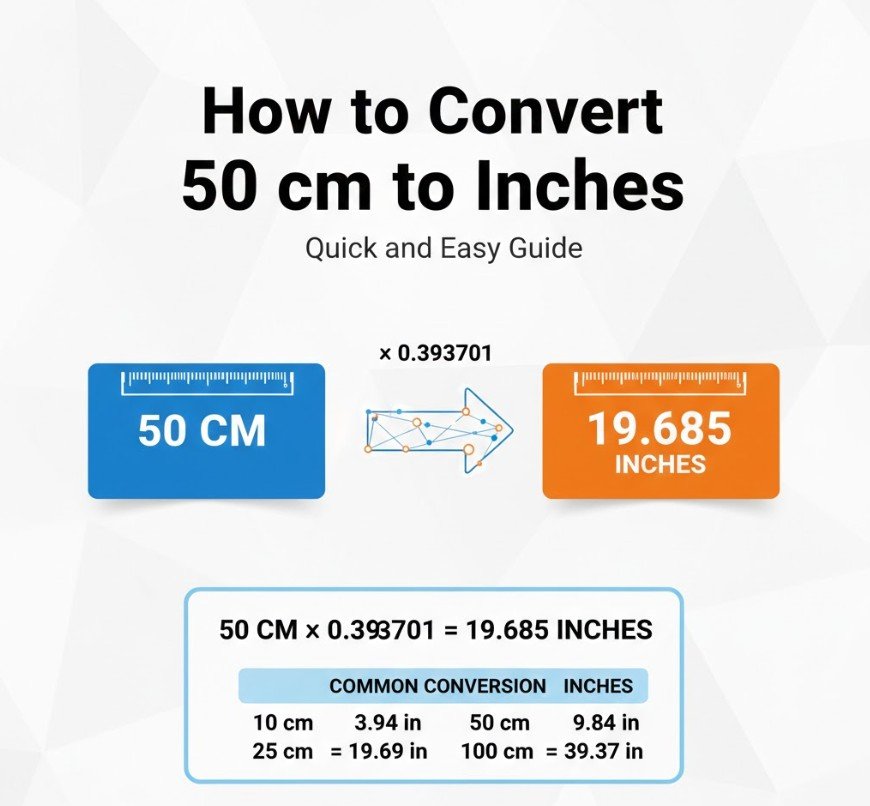
Converting units from centimeters (cm) to inches is a common task, whether you’re working on a DIY project, studying for a test, or simply navigating product measurements. But how do you convert 50 cm to inches accurately? In this step-by-step guide, we’ll break down the process for you, explore related conversions, and even provide some examples to make this easy to understand.
In addition, we’ll answer related questions such as how to convert 1 inch to cm, how to convert 10 inches to cm, and how to handle other measurements like millimeters (mm) to inches. By the end of this guide, you’ll be able to convert 50 cm to inches and other similar conversions with confidence. Let’s dive in!
What is the Conversion Formula for cm to Inches?
Before we get into specific conversions, let’s start with the basic formula used to convert centimeters to inches.
1 inch is equal to 2.54 cm. To convert centimeters to inches, you divide the number of centimeters by 2.54.
Formula:
Inches=2.54Centimeters
Example: Converting 50 cm to Inches
To convert 50 cm to inches using the formula:Inches=2.5450≈19.685 inches
So, 50 cm is approximately 19.69 inches. It’s important to round to the nearest hundredth when you need to present your results in everyday measurements. This basic formula will help you in nearly every cm to inch conversion scenario.
Also Read: How to Convert 3 Meters to Feet in Seconds
The Importance of Unit Conversions in Everyday Life
Conversions between units of measurement are essential in many fields, from cooking and construction to science and travel. Understanding how to convert between centimeters and inches is especially useful in countries like the United States, where inches are the standard unit for length, whereas most other countries use the metric system. Here are a few scenarios where these conversions might come in handy:
- Buying Furniture: When shopping online, measurements may be provided in centimeters, but your measuring tape is in inches.
- Design & Construction: Engineers, architects, and designers may need to convert measurements when planning or creating blueprints.
- Travel & Maps: When you’re traveling internationally, road signs, distances, and maps may require unit conversions.
Step-by-Step Conversion: From 50 cm to Inches
As demonstrated, converting 50 cm to inches involves simple division. Here is a breakdown of how to do it in different scenarios.
Converting 1 inch to cm
It’s also essential to know the reverse of the conversion: 1 inch to cm. As mentioned earlier, 1 inch equals exactly 2.54 cm. So, if you need to go the other way, simply multiply by 2.54 instead of dividing.
Example:
- To convert 1 inch to cm:
1 inch=2.54 cm
Why Is This Useful?
Knowing how to convert 1 inch to cm allows you to go both ways in your conversion process. If you find a measurement in inches but need it in centimeters, just multiply the number of inches by 2.54.
Other Common Conversions You Might Need
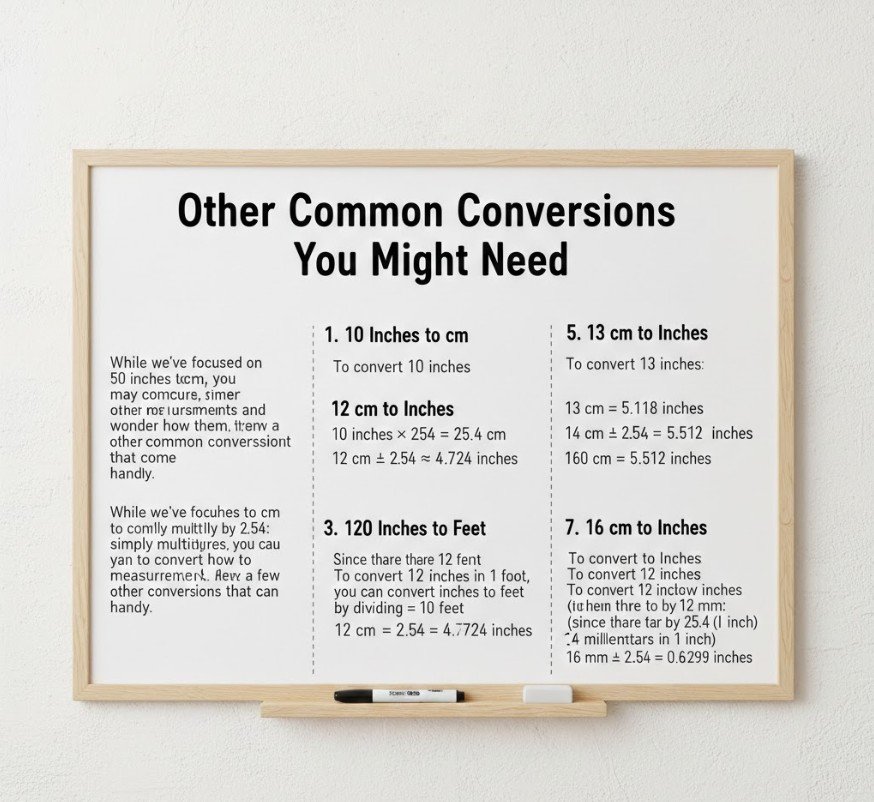
While we’ve focused on 50 cm to inches, you may come across other measurements and wonder how to convert them. Here are a few other common conversions that can come in handy:
Also Read: How to Convert 10 mm to Inches in a Flash
1. 10 Inches to cm
To convert 10 inches to centimeters, simply multiply by 2.54:10 inches×2.54=25.4 cm
2. 12 cm to Inches
To convert 12 cm to inches, divide by 2.54:12 cm÷2.54≈4.724 inches
3. 120 Inches to Feet
Since there are 12 inches in 1 foot, you can convert inches to feet by dividing by 12:120 inches÷12=10 feet
4. 12 cm to Inches
This is another common conversion. To convert 12 cm to inches, divide 12 by 2.54:12 cm÷2.54≈4.724 inches
5. 13 cm to Inches
To convert 13 cm to inches:13 cm÷2.54≈5.118 inches
6. 14 cm to Inches
To convert 14 cm to inches:14 cm÷2.54≈5.512 inches
7. 160 cm to Inches
To convert 160 cm to inches:160 cm÷2.54≈62.992 inches
8. 16mm to Inches
To convert millimeters to inches, divide by 25.4 (since there are 25.4 millimeters in 1 inch):16 mm÷25.4≈0.6299 inches
9. 180 cm to Inches
To convert 180 cm to inches:180 cm÷2.54≈70.866 inches
10. 18mm to Inches
To convert 18 mm to inches:18 mm÷25.4≈0.7087 inches
11. 20 mm to Inches
To convert 20 mm to inches:20 mm÷25.4≈0.7874 inches
12. 200mm to Inches
To convert 200 mm to inches:200 mm÷25.4≈7.874 inches
13. 22 cm to Inches
To convert 22 cm to inches:22 cm÷2.54≈8.661 inches
14. 28 cm to Inches
To convert 28 cm to inches:28 cm÷2.54≈11.024 inches
15. 2mm to Inches
To convert 2 mm to inches:2 mm÷25.4≈0.0787 inches
16. 300mm to Inches
To convert 300 mm to inches:300 mm÷25.4≈11.811 inches
17. 35mm to Inches
To convert 35 mm to inches:35 mm÷25.4≈1.378 inches
18. 3cm to Inches
To convert 3 cm to inches:3 cm÷2.54≈1.181 inches
19. 4 Feet in Inches
Since there are 12 inches in 1 foot, to convert 4 feet to inches:4 feet×12=48 inches
Also Read: How to Convert mm to Inches Quickly – A Complete Guide
Practical Examples and How You Can Use These Conversions
Now that you know how to convert between centimeters, inches, and millimeters, let’s explore how these conversions can be useful in real-world scenarios.
Example 1: Buying a TV
When buying a TV, the size is often given in inches. Suppose you want to convert the size from centimeters to inches to get a better sense of the dimensions. If the TV screen is 120 cm, you can easily convert that to inches:120 cm÷2.54=47.244 inches
So, the TV would be approximately 47.24 inches.
Example 2: Cooking Measurements
Some recipes may give measurements in centimeters, especially in international cookbooks. If you need to know the equivalent in inches for some measuring tools or ingredients, the conversion process can help. For example, 10 cm is about 3.94 inches, which could help when using kitchen tools that measure in inches.
Conclusion
Understanding how to convert 50 cm to inches is just one part of the broader picture of mastering unit conversions. Whether you’re working with centimeters, inches, or millimeters, knowing how to perform these conversions will help you navigate a wide variety of tasks and measurements.
As we’ve seen, the formula for converting cm to inches is simple: divide the number of centimeters by 2.54. Beyond just 50 cm to inches, this knowledge extends to other common conversions like 1 inch to cm, 10 inches to cm, and 12 cm to inches. It’s always a good idea to keep a conversion calculator or chart handy for more complex measurements or to verify your results.
Whether you’re measuring items for a home project, calculating distances for travel, or simply curious about how different units compare, knowing how to convert between centimeters, inches, and millimeters will always be useful.
Frequently Asked Questions (FAQs)
1. How do I convert centimeters to inches without a calculator?
To convert cm to inches manually, divide the number of centimeters by 2.54. For example, 10 cm divided by 2.54 equals 3.94 inches.
2. How many inches is 100 cm?
To convert 100 cm to inches, divide by 2.54:100 cm÷2.54=39.37 inches
3. Why is the conversion factor 2.54?
The conversion factor of 2.54 comes from the exact relationship between the metric and imperial systems. One inch is defined as 2.54 centimeters.
