

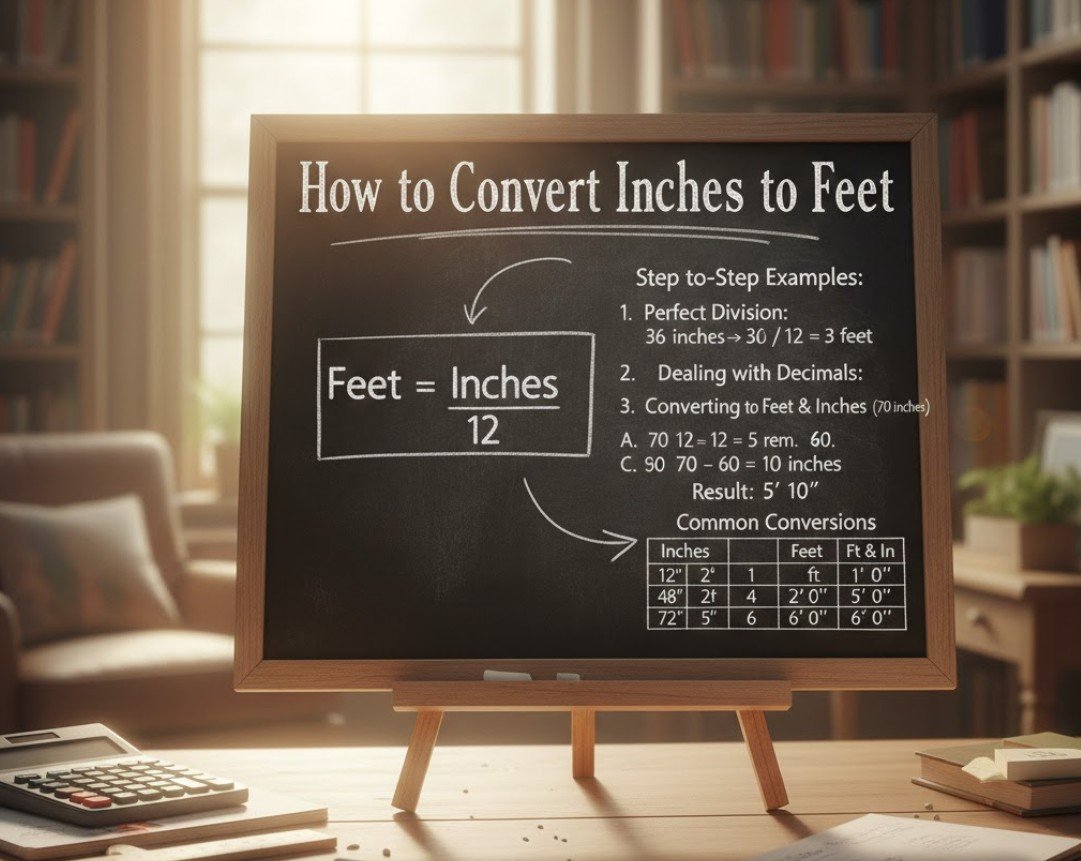
Understanding how to convert inches to feet is an essential life skill that applies to everyday situations such as measuring height, home improvement, construction, fitness tracking, education, and international unit conversion. Whether you are converting a person’s height, interpreting architectural plans, or comparing measurements across metric and imperial systems, accurate unit conversion ensures clarity and prevents costly mistakes.
Many people struggle when switching between inches, feet, and centimeters because these systems use different base values. This guide explains inches to feet, feet to inches, and centimeter to feet and inches conversions in a clear, step-by-step way. You will also find real-world examples like 160 cm to feet inch, 168 cm to feet and inches, and 6 feet 1 inch to cm, all explained in detail.
By the end of this article, you will confidently convert measurements between inches, feet, and centimeters without relying solely on calculators.
Understanding Inches, Feet, and Centimeters
Before learning how to convert inches to feet, it helps to understand how these units relate to one another. Inches and feet are part of the imperial system, commonly used in the United States and parts of the United Kingdom, while centimeters belong to the metric system, used worldwide.
One foot equals 12 inches. This fixed relationship makes inch to feet and feet to inches conversions straightforward. On the metric side, one inch equals 2.54 centimeters, which allows accurate conversion between centimeters to feet and inches.
How to Convert Inches to Feet
The most important rule when learning how to convert inches to feet is remembering that 12 inches equal 1 foot. To convert inches to feet, you divide the total number of inches by 12.
For example, converting 24 inches to feet means dividing 24 by 12, which equals 2 feet. This same method applies to larger or smaller values and is the foundation of inches to feet conversion.
When dealing with partial feet, the remainder becomes inches. This is how inches to inches and feet calculations work in practical use.
Inches to Feet and Inches Explained
Sometimes measurements are easier to read when expressed as feet and inches rather than decimals. This is where inches to inches and feet becomes useful.
If you have 70 inches, dividing by 12 gives 5 feet with a remainder of 10 inches. That result is written as 5 feet 10 inches. This approach is common in height measurement and carpentry.
Understanding this relationship also makes feet inches to inches conversion easier, because you simply multiply the feet by 12 and add the remaining inches.
Feet to Inches Conversion Made Simple
Converting feet to inches is even simpler than converting inches to feet. Since each foot contains 12 inches, you multiply the number of feet by 12.
For example, 6 feet equals 72 inches. If a measurement includes inches as well, such as 5 feet 7 inches, you multiply 5 by 12 and then add 7.
This same logic applies when converting feet inches to inches, which is commonly needed in design, construction, and sports measurement.
Also Read: How to Easily Convert 165.1 cm to Feet
Converting Centimeters to Feet and Inches
Many people search for centimeter to feet and inches because height measurements are often given in centimeters outside the US. The conversion involves two steps: converting centimeters to inches, then converting inches to feet.
Since one inch equals 2.54 centimeters, you divide the centimeter value by 2.54 to get inches. You then divide those inches by 12 to determine feet and remaining inches.
This method applies to cm to feet and inches, centimeters to feet and inches, and centimetres to inches and feet, which all refer to the same process using different spelling variations.
160 cm to Feet Inch Explained
When converting 160 cm to feet inch, divide 160 by 2.54 to get approximately 62.99 inches. Dividing that by 12 gives 5 feet with a remainder of about 2.99 inches. Rounded to the nearest inch, 160 cm equals approximately 5 feet 3 inches.
This conversion is commonly used in medical records, fitness tracking, and clothing size charts.
161 cm to Feet and Inches Conversion
The conversion of 161 cm to feet and inches follows the same steps. Dividing 161 by 2.54 results in approximately 63.39 inches. This equals 5 feet 3.4 inches, which is typically rounded to 5 feet 3 inches.
167 cm to Feet and Inches Explained
To convert 167 cm to feet and inches, divide by 2.54 to get approximately 65.75 inches. This equals 5 feet 5.75 inches, commonly rounded to 5 feet 6 inches.
168 cm to Feet and Inches Conversion
When converting 168 cm to feet and inches, the result is about 66.14 inches. This equals 5 feet 6 inches when rounded, making it a very common height conversion.
174 cm to Feet and Inches Conversion
For 174 cm to feet and inches, dividing by 2.54 gives approximately 68.5 inches. This equals 5 feet 8.5 inches, often rounded to 5 feet 9 inches.
175 cm to Feet and Inches Explained
The conversion of 175 cm to feet and inches results in approximately 68.9 inches. This equals about 5 feet 9 inches, a frequently referenced height in health and sports contexts.
Also Read: How Long Do You Boil Eggs? The Ultimate Guide for Perfect Eggs
Converting Feet and Inches to Centimeters
The reverse process is equally important. To convert feet and inches to centimeters, multiply the number of feet by 12, add the inches, and then multiply the total inches by 2.54.
This process applies to feet and inches to cm, feet and inches to centimeters, feet inch to centimeter, feet inches to cm, feet inch to cm, and even variations like feet a n d inches to cm, which all describe the same conversion.
5 Feet and 7 Inches to cm Explained
To convert 5 feet and 7 inches to cm, multiply 5 by 12 to get 60 inches, then add 7 for a total of 67 inches. Multiplying 67 by 2.54 gives 170.18 cm.
5 Feet and 8 Inches to cm Conversion
The conversion of 5 feet and 8 inches to cm starts with 5 times 12 plus 8, giving 68 inches. Multiplying by 2.54 results in 172.72 cm.
6 Feet 1 Inch to cm Explained
For 6 feet 1 inch to cm, multiply 6 by 12 and add 1 to get 73 inches. Multiplying by 2.54 results in 185.42 cm.
Inches to Feet vs Inches to Inches and Feet
While inches to feet produces a decimal result, inches to inches and feet expresses the same value in a more readable format. Both methods are correct, but the choice depends on context. Builders often prefer feet and inches, while engineers may prefer decimals.
Feet Inches to Inches Conversion Explained
When converting feet inches to inches, you combine all measurements into a single unit. This is especially useful when working with formulas or digital tools that require uniform units.
Why These Conversions Matter in Real Life
Conversions between inches, feet, and centimeters are used daily in healthcare, fitness, construction, aviation, fashion, and education. Accurate measurement conversion reduces errors, improves communication, and ensures compliance with international standards.
Also Read: How to Use a Compass: A Beginner’s Guide to Navigation
Conclusion: Mastering How to Convert Inches to Feet
Learning how to convert inches to feet empowers you to move confidently between measurement systems. Whether converting cm to feet and inches, calculating feet to inches, or translating heights like 160 cm to feet inch or 6 feet 1 inch to cm, the formulas remain consistent and reliable.
By understanding the logic behind these conversions rather than memorizing numbers, you gain a practical skill that applies across professions and everyday life.
Frequently Asked Questions
What is the easiest way to convert inches to feet?
Divide the number of inches by 12 to get feet.
How do I convert centimeters to feet and inches?
Divide centimeters by 2.54 to get inches, then divide by 12.
Why are feet and inches still used?
They remain standard in countries like the US and UK for height, construction, and design.
Are rounded conversions acceptable?
Yes, rounding is common for everyday use, but exact values are preferred in technical fields.
