

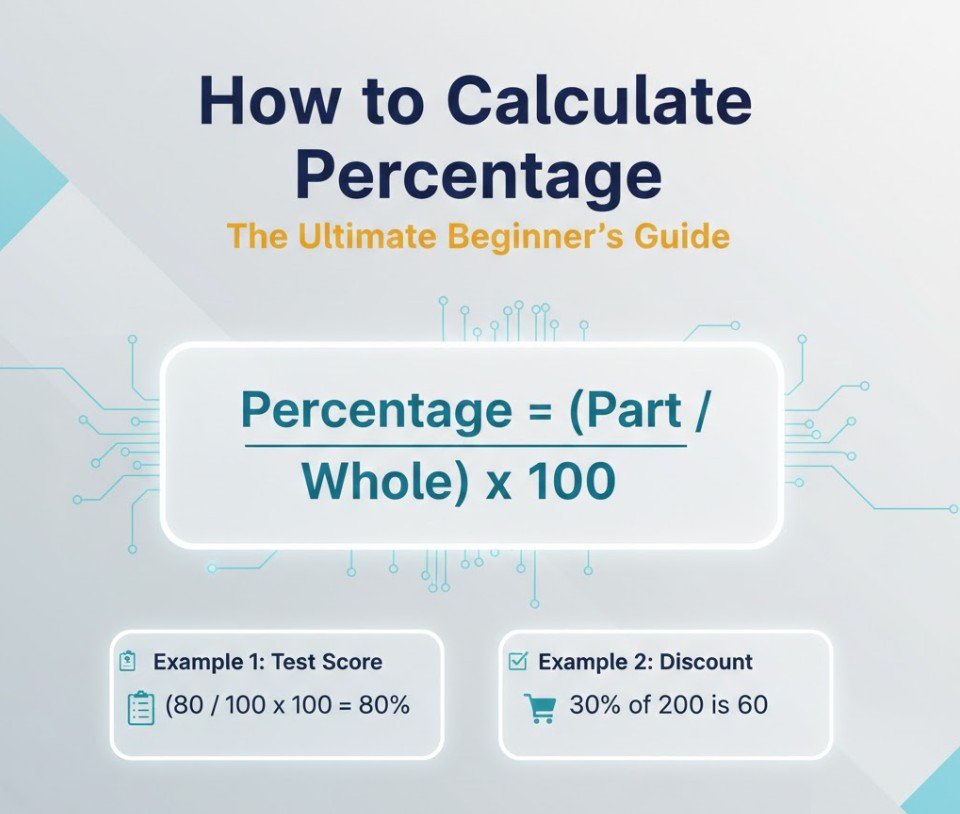
Percentages are a fundamental concept in both everyday life and in various fields such as mathematics, finance, and business. Whether you’re trying to figure out how much a product costs after a discount or how to calculate a percentage increase in your salary, understanding how to calculate percentages is essential. In this guide, we will walk you through the process of how to calculate percentages, including several common scenarios such as percentage increase, change, and conversions.
What is a Percentage?
A percentage is a way of expressing a number as a fraction of 100. It is often used to represent proportions, comparisons, and changes between numbers. When you see a percentage, such as 25%, it means 25 out of every 100 units.
For example, if a class has 25 students, and 10 are absent, the percentage of students absent is calculated by dividing the number of absent students (10) by the total number of students (25), then multiplying by 100 to convert it into a percentage:(2510)×100=40%
This shows that 40% of the students are absent.
How to Calculate Percentage: The Basics
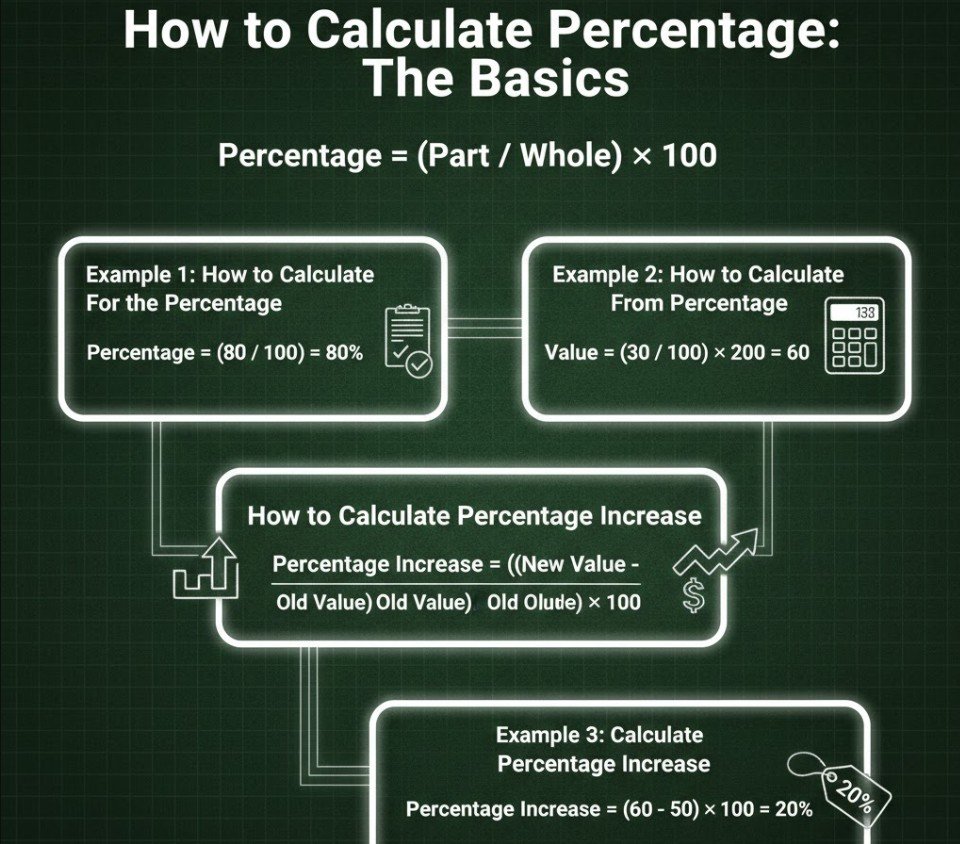
The basic formula for calculating a percentage is:Percentage=(WholePart)×100
Where:
- Part is the specific value you’re interested in (for example, a number of items or a portion of a total).
- Whole is the total value or the base you’re comparing against.
Also Read: How to Pronounce Commonly Mispronounced Words & Names | Easy Guide
Example 1: How to Calculate For the Percentage
Let’s say you scored 80 marks out of 100 in a test. To find your percentage score:Percentage=(10080)×100=80%
You’ve scored 80% in the test.
Example 2: How to Calculate From Percentage
Now, if you want to find the value from a percentage, you can use this formula:Value=(100Percentage)×Total
Let’s say you need to find 30% of 200. Using the formula:Value=(10030)×200=60
So, 30% of 200 is 60.
How to Calculate Percentage Increase
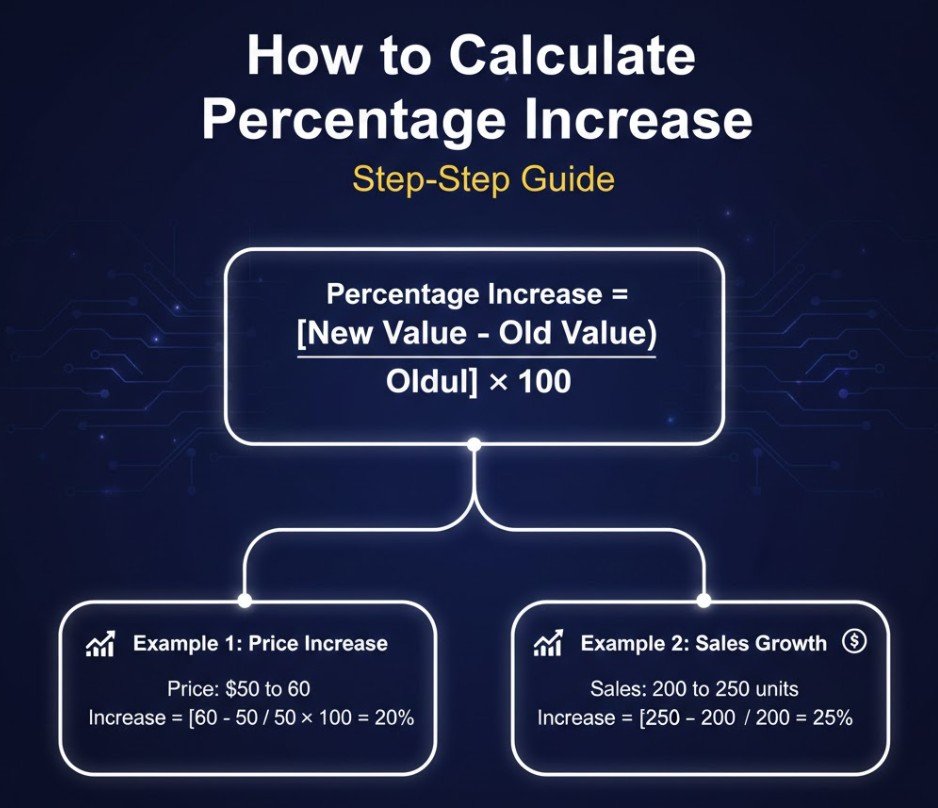
Calculating percentage increase is often used when comparing an old value to a new, higher value, such as the price of a product before and after a price hike.
The formula for percentage increase is:Percentage Increase=(Old ValueNew Value−Old Value)×100
Example 3: How to Calculate Percentage Increase
Suppose the price of a product was $50 and is now $60. To calculate the percentage increase:Percentage Increase=(5060−50)×100=(5010)×100=20%
So, the price increased by 20%.
Also Read: How to Convert Inches to Feet Easily (Step-by-Step Guide)
How to Calculate Increase as a Percentage
If you want to calculate how much an increase represents as a percentage, use the same formula for percentage increase as above.
Example 4: How to Calculate Increase as a Percentage
Let’s say you earned $1000 last month, and this month you earned $1200. To find the percentage increase in your earnings:Percentage Increase=(10001200−1000)×100=(1000200)×100=20%
You received a 20% increase in your earnings.
How to Calculate Percentage Change
Percentage change can refer to either an increase or a decrease. To calculate percentage change, the formula is:Percentage Change=(Old ValueNew Value−Old Value)×100
If the new value is smaller than the old value, this results in a negative percentage, indicating a decrease.
Example 5: How to Calculate Percentage Change
Let’s say your sales decreased from 500 units to 300 units. To calculate the percentage change:Percentage Change=(500300−500)×100=(500−200)×100=−40%
This means your sales have decreased by 40%.
How to Calculate Percentage Increase of a Percentage
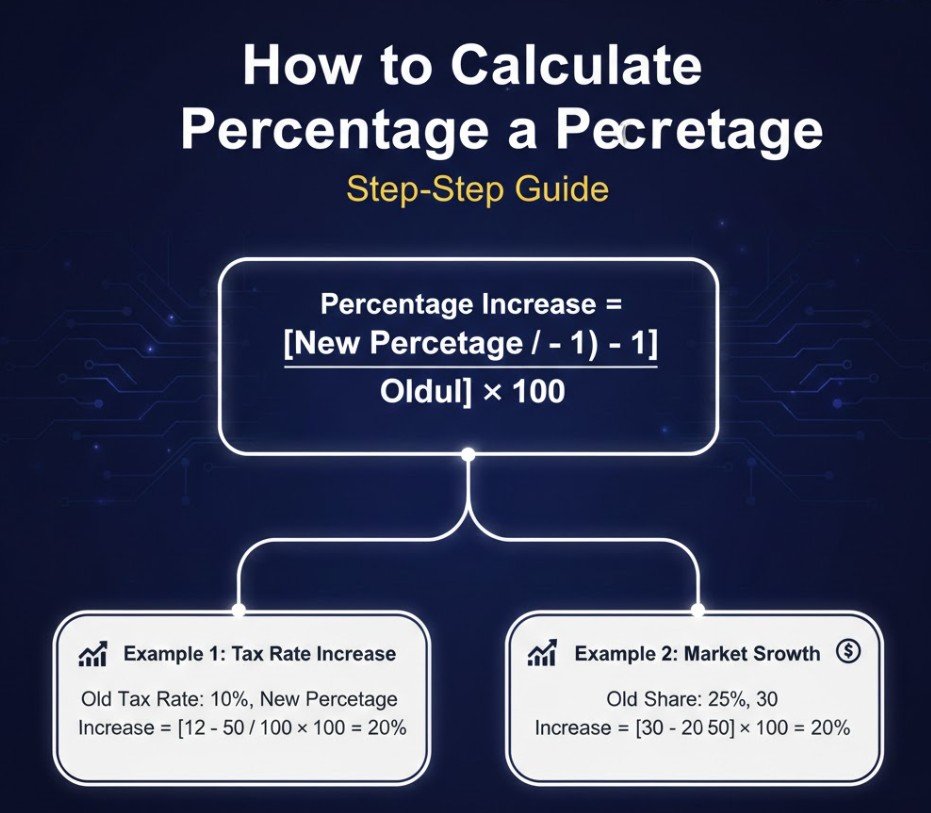
In some cases, you may need to calculate the increase of a percentage, such as when an increase is applied to a given percentage. The process follows the same steps as calculating a regular percentage increase.
Example 6: How to Calculate Percentage Increase of a Percentage
Let’s say you have a discount rate of 10%, and you want to increase that rate by 15%. To calculate the new discount percentage:Percentage Increase=(10015)×10=1.5
Now, add this increase to the original percentage:New Percentage=10%+1.5%=11.5%
So, the new discount rate is 11.5%.
Also Read: How to Easily Convert 165.1 cm to Feet
How to Calculate by Percentage
Calculating by percentage is a common method for determining values based on a given percentage. This approach is typically used in financial calculations or when determining commissions or taxes.
The formula for calculating by percentage is:Value=Percentage×Amount
Example 7: How to Calculate by Percentage
If you need to calculate 5% of $200:Value=1005×200=10
So, 5% of $200 is $10.
How to Calculate Into Percentage
Converting a value into a percentage involves dividing the value by the total and then multiplying by 100 to express it as a percentage.
The general formula is:Percentage=(TotalValue)×100
Example 8: How to Calculate Into Percentage
Suppose you scored 45 points out of 50 on a quiz. To calculate the percentage score:Percentage=(5045)×100=90%
Thus, your score is 90%.
Practical Applications of Calculating Percentages
Knowing how to calculate percentages can help you in a wide variety of practical situations. Here are a few examples:
- Shopping Discounts: Understanding how to calculate percentage discounts can help you determine the final price after a sale.
- Finance and Budgeting: Calculating interest rates, tax rates, and investment returns often involves percentage-based calculations.
- Work and Productivity: Tracking performance metrics like sales growth, efficiency rates, and employee bonuses often requires percentage calculations.
Conclusion
Understanding how to calculate percentage is a crucial skill, whether you’re dealing with finance, shopping, or simply calculating performance metrics. By mastering the various methods of percentage calculation, including percentage increase, percentage change, and conversion between values and percentages, you can make more informed decisions in everyday life.
The key formulas for calculating percentages can be summarized as follows:
- Basic Percentage: Percentage=(WholePart)×100
- Percentage Increase: Percentage Increase=(Old ValueNew Value−Old Value)×100
- Percentage Change: Percentage Change=(Old ValueNew Value−Old Value)×100
- Calculating From a Percentage: Value=(100Percentage)×Total
- Calculating Into Percentage: Percentage=(TotalValue)×100
FAQs
Q1: How do I calculate percentage increase?
To calculate percentage increase, subtract the old value from the new value, then divide by the old value and multiply by 100.
Q2: How can I calculate a percentages of a number?
Multiply the percentage by the number and divide by 100.
Q3: How do I calculate percentages decrease?
Use the percentage change formula, but if the new value is smaller than the old value, you will get a negative result indicating a decrease.
