

When working with measurements, one of the most common tasks is converting between millimeters and inches. For example, you might need to know how to convert 10 mm to inches for a project, design work, or even when buying items from international markets. If you’ve found yourself asking, “How do I convert mm to inches?”, you’re in the right place.
In this guide, we’ll not only show you how to easily convert 10 mm to inches, but we’ll also cover other popular millimeter to inches conversions, like 5 mm to inches, 20 mm to inches, 30 mm to inches, and many more. Plus, we’ll break down the steps to make it simple and straightforward for you to convert millimeters to inches every time.
Let’s dive in and start with the basic concept!
What is the Conversion Formula for mm to Inches?
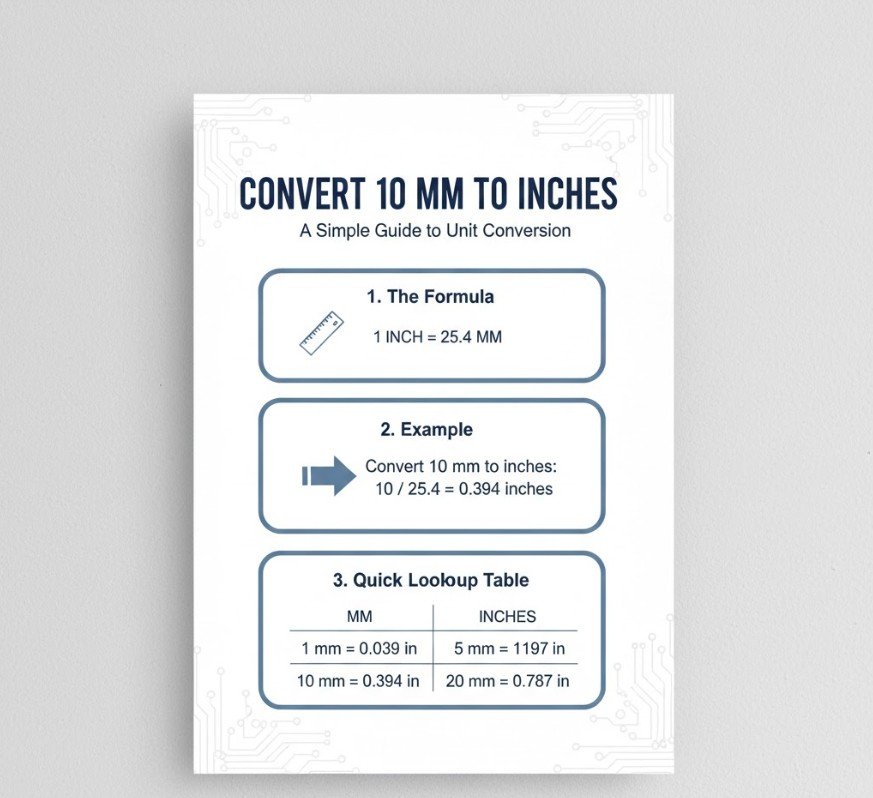
To convert millimeters (mm) to inches, we use a simple conversion formula:Inches=Millimeters÷25.4
This formula works because there are exactly 25.4 millimeters in one inch. So, if you’re trying to convert a value from millimeters to inches, simply divide the number of millimeters by 25.4.
For instance, to convert 10 mm to inches:10mm÷25.4=0.3937inches
So, 10 mm is approximately 0.3937 inches.
This simple process can be applied to any millimeter-to-inch conversion. Let’s explore how to convert other common millimeter measurements to inches.
Converting 20 mm to Inches
If you need to convert 20 mm to inches, you would use the same formula:20mm÷25.4=0.7874inches
Therefore, 20 mm is roughly 0.7874 inches.
This conversion can be handy when dealing with small items, like screws or jewelry, where precise measurements are required. Knowing how to convert mm to inches allows you to shop and measure accurately, whether you’re working in a local or international context.
Converting 30 mm to Inches
Let’s now convert 30 mm to inches:30mm÷25.4=1.1811inches
So, 30 mm equals approximately 1.1811 inches.
This is useful in various scenarios, such as when you’re looking at larger components, or if you’re trying to convert dimensions for products that are typically measured in millimeters but need to be understood in inches.
How to Convert 100 mm to Inches
For bigger measurements, like converting 100 mm to inches, follow the same method:100mm÷25.4=3.937inches
So, 100 mm is about 3.937 inches.
Understanding the conversion of 100 mm to inches can come in handy for larger mechanical, engineering, or architectural projects, where accurate dimensions are essential.
Converting 5 mm to Inches
When converting smaller values, such as 5 mm to inches:5mm÷25.4=0.1969inches
This means 5 mm is approximately 0.1969 inches.
Small measurements like this are common when dealing with fine electronics, intricate tools, or measurements that require very tight tolerances.
Also Read: How to Convert 20 cm to Inches with Ease
How to Convert 50 mm to Inches
Let’s now take a look at converting 50 mm to inches:50mm÷25.4=1.9685inches
So, 50 mm is roughly 1.9685 inches.
This is a handy conversion for mid-sized components, such as small parts in machinery, where both millimeter and inch measurements are often used.
Converting 12 mm to Inches
To convert 12 mm to inches:12mm÷25.4=0.4724inches
Thus, 12 mm is approximately 0.4724 inches.
This type of measurement is often found in applications that require slight variations in dimensions, such as hardware fittings or machine parts.
Converting 300 mm to Inches
For larger measurements like 300 mm, you would use the same method:300mm÷25.4=11.811inches
So, 300 mm equals about 11.811 inches.
This is a common conversion for medium to large-scale industrial or construction work, where you need to calculate larger lengths and dimensions.
Converting 25 mm to Inches
To convert 25 mm to inches:25mm÷25.4=0.9843inches
Thus, 25 mm is approximately 0.9843 inches.
This conversion is common for smaller objects like fasteners, medical instruments, or hardware parts, which often come in these sizes.
Also Read: How to Convert mm to Inches Quickly – A Complete Guide
Converting 15 mm to Inches
For 15 mm to inches, the calculation would be:15mm÷25.4=0.5906inches
So, 15 mm is roughly 0.5906 inches.
This size is typically seen in consumer products, such as electronic devices, where small yet precise measurements are needed.
Converting 40 mm to Inches
Next, let’s convert 40 mm to inches:40mm÷25.4=1.5748inches
So, 40 mm is about 1.5748 inches.
This is often seen in the automotive, electronics, and construction industries, where parts are frequently measured in millimeters and require inch conversions for compatibility.
Converting 256 mm to Inches
For a more specific measurement, let’s convert 256 mm to inches:256mm÷25.4=10.0787inches
So, 256 mm is approximately 10.0787 inches.
This conversion can be useful in various industries like manufacturing, where non-standard sizes are used frequently.
Converting 60 mm to Inches
When converting 60 mm to inches:60mm÷25.4=2.3622inches
Therefore, 60 mm is roughly 2.3622 inches.
This size is often seen in parts for machinery, small equipment, and other industrial uses.
Converting 8 mm to Inches
To convert 8 mm to inches:8mm÷25.4=0.3149inches
So, 8 mm is approximately 0.3149 inches.
This conversion can be useful when working with small precision parts or in applications like crafting.
Converting 16 mm to Inches
For converting 16 mm to inches:16mm÷25.4=0.6299inches
So, 16 mm is roughly 0.6299 inches.
Such conversions are commonly used in the context of screws, washers, or other small parts that require precise measurement.
Also Read: How to Convert 15 cm to Inches: A Complete Guide
Converting 6 mm to Inches
Finally, to convert 6 mm to inches:6mm÷25.4=0.2362inches
Thus, 6 mm is approximately 0.2362 inches.
This is a small measurement that could be found in a wide range of applications, from electronics to fabric measurements.
Understanding MM to Inches Fraction Conversion
Sometimes, it’s useful to express millimeter measurements as fractions of an inch. The fraction equivalent of 10 mm to inches, for example, is approximately 13/32 inches, as 0.3937 inches is close to this fraction. This approach is particularly helpful in industries like woodworking or metalworking, where fractions of an inch are often used.
Conclusion: Mastering the MM to Inches Conversion
Converting from millimeters to inches is straightforward once you understand the formula and basic math behind it. Whether you need to convert 10 mm to inches or other common millimeter values like 5 mm to inches, 20 mm to inches, or even 300 mm to inches, the process is simple: divide the number of millimeters by 25.4.
By keeping the conversion formula handy, you can ensure accurate measurements for any project or application. And now that you’re equipped with the knowledge of converting mm to inches, you can easily handle a wide variety of measurement conversions.
FAQs
1. How do I convert 10 mm to inches without a calculator?
To convert 10 mm to inches without a calculator, you can remember that 1 inch equals 25.4 mm. So, divide the millimeter value by 25.4 to get the equivalent in inches.
2. Can I use an online tool to convert mm to inches?
Yes! There are many online tools available that can quickly convert mm to inches. However, knowing the conversion formula will give you a better understanding of the process.
3. Why is it important to know how to convert mm to inches?
Knowing how to convert mm to inches is essential in various fields, such as engineering, construction, and product design, where both metric and imperial measurements are often used.
For More Visit Fex Novo
