

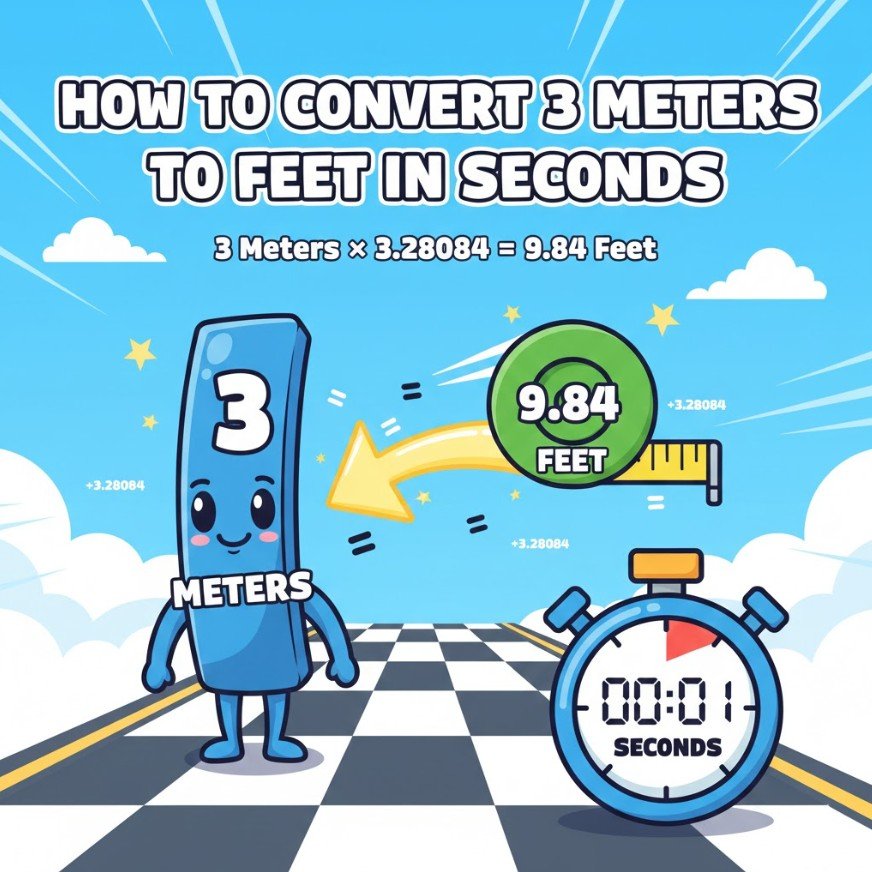
If you’ve ever needed to convert meters to feet, whether for personal, academic, or professional reasons, you’ll know that understanding this simple conversion can make a big difference. In this guide, we’ll show you how to convert 3 meters to feet, as well as explain how to easily convert other measurements like 5 meters to feet, 10 meters to feet, and beyond.
In addition to providing you with a quick answer, we’ll also explain the formula for meters to feet conversion, give examples, and answer any common questions you may have. So, whether you’re working on a DIY project, reading an international measurement system, or simply curious, you’ve come to the right place.
What is Meters to Feet Conversion?
When measuring length or distance, different countries use different units of measurement. In the metric system, the meter (m) is the standard unit of length. However, the United States, along with a few other countries, predominantly uses the Imperial system, where feet (ft) are used to measure length.
To make sense of these measurements, you often need to convert between meters and feet. Converting meters to feet allows for clearer communication, especially when working with individuals who use the Imperial system. Whether you’re shopping for furniture, dealing with construction projects, or simply trying to understand distances in a different country, knowing how to convert between meters and feet is essential.
How to Convert 3 Meters to Feet
The process for converting 3 meters to feet is quite simple. To convert meters to feet, multiply the length in meters by the conversion factor, which is approximately 3.28084. Here’s the calculation for 3 meters to feet:
3 meters × 3.28084 = 9.84252 feet
Thus, 3 meters is equivalent to 9.84 feet (rounded to two decimal places).
Why is this Important?
Knowing how to quickly convert 3 meters to feet can be particularly useful in various situations. For example, when you’re traveling abroad, buying property, or dealing with products from other countries that list measurements in meters, you’ll need to understand how to make these conversions quickly.
Also Read: How Many Square Feet Are There in an Acre? Find Out Here
Meters to Feet Formula: A Simple Guide
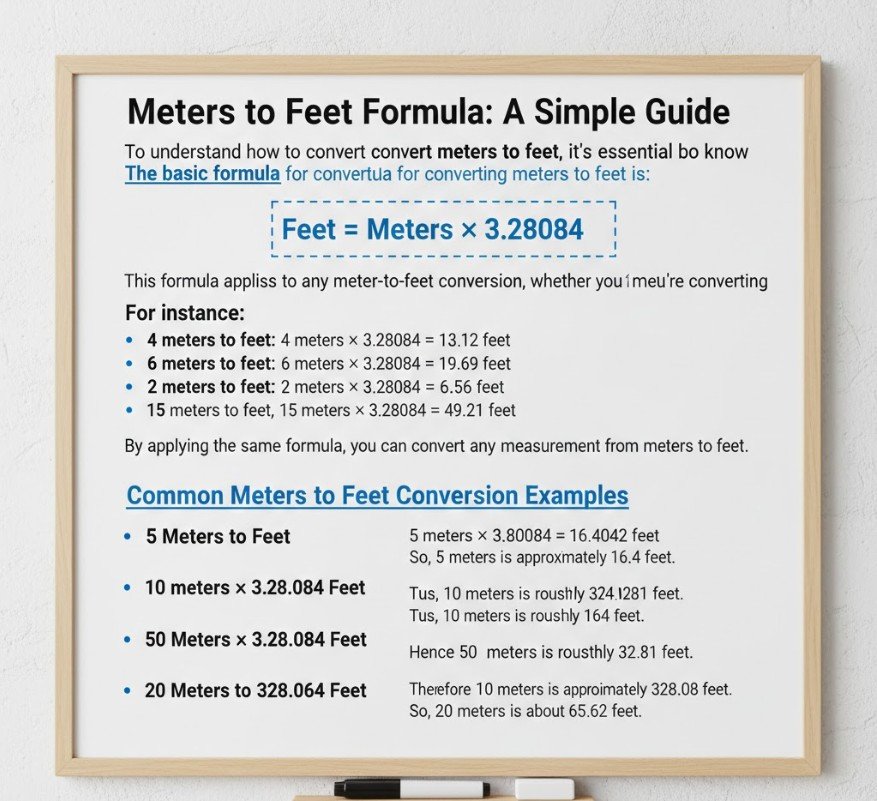
To understand how to convert meters to feet, it’s essential to know the formula. The basic formula for converting meters to feet is:
Feet = Meters × 3.28084
This formula applies to any meter-to-feet conversion, whether you’re converting 1 meter to feet, 50 meters to feet, or even 200 meters to feet.
For instance:
- 4 meters to feet: 4 meters × 3.28084 = 13.12 feet
- 6 meters to feet: 6 meters × 3.28084 = 19.69 feet
- 2 meters to feet: 2 meters × 3.28084 = 6.56 feet
- 15 meters to feet: 15 meters × 3.28084 = 49.21 feet
By applying the same formula, you can convert any measurement from meters to feet.
Common Meters to Feet Conversion Examples
To help make this clearer, let’s dive into more practical examples for common measurements.
5 Meters to Feet
To convert 5 meters to feet:
5 meters × 3.28084 = 16.4042 feet
So, 5 meters is approximately 16.4 feet.
10 Meters to Feet
Now, let’s convert 10 meters to feet:
10 meters × 3.28084 = 32.8084 feet
Thus, 10 meters is roughly 32.81 feet.
50 Meters to Feet
To convert 50 meters to feet:
50 meters × 3.28084 = 164.042 feet
Hence, 50 meters equals about 164 feet.
100 Meters to Feet
To convert 100 meters to feet:
100 meters × 3.28084 = 328.084 feet
Therefore, 100 meters is approximately 328.08 feet.
20 Meters to Feet
For 20 meters to feet:
20 meters × 3.28084 = 65.6168 feet
So, 20 meters is about 65.62 feet.
Also Read: How to Convert Inches to Feet: A Complete Guide to Inch to Foot Conversion
Why Is Converting Meters to Feet Important?
Understanding how to convert meters to feet can be important for several reasons, such as:
- International Travel: Different countries use different measurement systems. When you visit a country that uses the metric system (like most of Europe), you may need to convert distances into feet to understand distances.
- Construction and Design: If you’re building or remodeling a home, you may find construction materials or designs that use meters. Knowing how to convert meters to feet helps when you’re working with suppliers, contractors, or engineers who use feet in their measurements.
- Science and Engineering: Many fields like physics, engineering, and architecture require metric-to-imperial conversions to work on international projects. Accurate conversions ensure the success of the projects.
- Sports: In many sports, distances like running tracks or swimming pools may be measured in meters, but athletes and audiences in the U.S. are more familiar with feet. Converting meters to feet helps to understand distances better.
Conclusion
Converting meters to feet is a valuable skill, especially when traveling, working on construction projects, or engaging in international communication. By understanding the simple formula—feet = meters × 3.28084—you can easily convert any value from meters to feet, whether it’s 3 meters, 5 meters, 100 meters, or even smaller conversions like 1.5 meters to feet.
Next time you’re faced with the need to convert, you’ll know exactly what to do! With this guide, you can quickly find the length in feet, making conversions in seconds.
Frequently Asked Questions
What is 1 Meter in Feet?
One meter is equal to 3.28084 feet. This is the standard conversion factor used to convert any measurement from meters to feet.
How Do I Convert Larger Meters to Feet (100 Meters, 200 Meters, etc.)?
To convert larger values like 100 meters or 200 meters, simply multiply the value by 3.28084.
For example:
- 100 meters to feet: 100 meters × 3.28084 = 328.084 feet
- 200 meters to feet: 200 meters × 3.28084 = 656.168 feet
What About Smaller Meters Like 1.5 Meters to Feet?
To convert 1.5 meters to feet:
1.5 meters × 3.28084 = 4.92126 feet.
Thus, 1.5 meters is about 4.92 feet.
