

When working with measurements, particularly in technical fields, construction, or everyday tasks like sewing or DIY projects, it’s common to need to convert between different units of measurement. One of the most frequent conversions is from millimeters (mm) to inches. While these two units of length are used around the world, their different systems can sometimes cause confusion. If you’ve ever found yourself asking, “How do I convert mm to inches?” this guide will break down everything you need to know—quickly and easily.
In this article, we’ll explain how to convert mm to inches, provide specific examples like 5 mm to inches, 10 mm to inches, and 100 mm to inches, and even dive into mm to inches fractions. So, whether you need to convert small measurements like 6 mm to inches or larger ones like 300 mm to inches, you’ll have a solid understanding of the process.
Understanding Millimeters and Inches
Before diving into the conversion process, let’s first look at what millimeters and inches are, and how they relate to each other.
Millimeters (mm)
Millimeters (mm) are a metric unit of length in the International System of Units (SI). They are used in most parts of the world, particularly in scientific, engineering, and everyday contexts. There are 1,000 millimeters in one meter.
Inches (in)
Inches are a part of the imperial system of measurement and are commonly used in the United States, the United Kingdom, and other countries that still use imperial units. One inch is equivalent to 2.54 centimeters or approximately 25.4 millimeters.
How to Convert mm to Inches
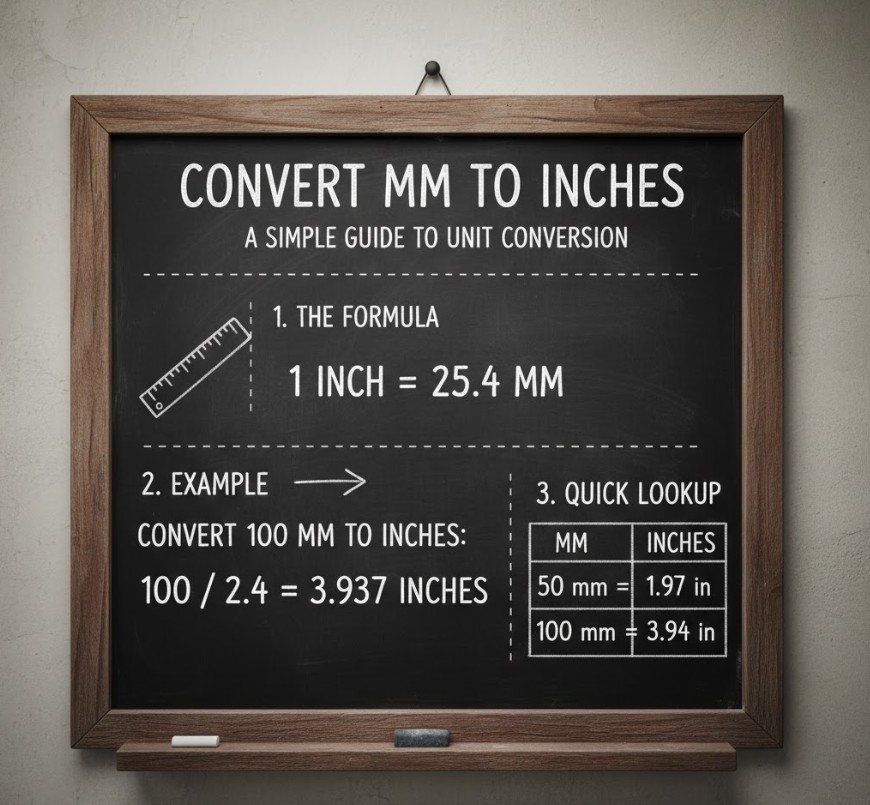
Converting mm to inches is a straightforward process that involves a simple mathematical formula. The key to this conversion lies in the fact that 1 inch equals 25.4 millimeters. Therefore, to convert millimeters to inches, you need to divide the number of millimeters by 25.4.
Conversion Formula
Inches = Millimeters ÷ 25.4
For example, to convert 10 mm to inches:
10 mm ÷ 25.4 = 0.3937 inches
This means that 10 mm equals approximately 0.39 inches.
Quick Conversion Table
To help you get started, here’s a quick conversion table for some common millimeter-to-inch conversions.
| Millimeters (mm) | Inches (in) |
|---|---|
| 5 mm | 0.1969 in |
| 6 mm | 0.2362 in |
| 8 mm | 0.3149 in |
| 10 mm | 0.3937 in |
| 12 mm | 0.4724 in |
| 15 mm | 0.5906 in |
| 16 mm | 0.6299 in |
| 20 mm | 0.7874 in |
| 25 mm | 0.9843 in |
| 30 mm | 1.1811 in |
| 40 mm | 1.5748 in |
| 50 mm | 1.9685 in |
| 60 mm | 2.3622 in |
| 100 mm | 3.9370 in |
| 256 mm | 10.0787 in |
| 300 mm | 11.8110 in |
Converting mm to Inches Fractions
Sometimes, it’s useful to express the result of your conversion in terms of fractions of an inch rather than decimal values. For example, if you’re working on a project where measurements need to be highly accurate, knowing the fraction equivalent of a measurement can be more practical.
To convert millimeters to fractions of an inch, you need to perform a few additional steps. After you convert the mm to a decimal value, you can round the decimal to the nearest fraction, such as 1/16, 1/8, 1/4, etc.
For instance:
- 5 mm = 0.1969 inches. The closest fraction is 3/16 inches.
- 10 mm = 0.3937 inches. The closest fraction is 25/64 inches.
Quick Guide for Converting mm to Inches Fractions
If you’re looking for a quick reference for common millimeter values, here’s a guide that can help you:
- 5 mm ≈ 3/16 in
- 10 mm ≈ 3/8 in
- 15 mm ≈ 5/8 in
- 20 mm ≈ 3/4 in
- 25 mm ≈ 1 inch
This is especially helpful for those working in construction or similar fields where using inches in fractional form is more common than decimal inches.
Also Read: How to Convert Inches to Feet: A Complete Guide to Inch to Foot Conversion
Examples of mm to Inches Conversion
Let’s take a closer look at some common mm to inches conversions to reinforce the process and give you a better understanding.
5 mm to Inches
To convert 5 mm to inches, you use the formula:
5 mm ÷ 25.4 = 0.1969 inches
This is roughly 3/16 inches in fraction form.
10 mm to Inches
For 10 mm to inches:
10 mm ÷ 25.4 = 0.3937 inches
This is approximately 25/64 inches.
20 mm to Inches
To convert 20 mm to inches:
20 mm ÷ 25.4 = 0.7874 inches
This is approximately 3/4 inches.
50 mm to Inches
For 50 mm to inches:
50 mm ÷ 25.4 = 1.9685 inches
This is roughly 1 15/16 inches.
100 mm to Inches
Converting 100 mm to inches:
100 mm ÷ 25.4 = 3.9370 inches
This is approximately 3 15/16 inches.
300 mm to Inches
For larger conversions like 300 mm:
300 mm ÷ 25.4 = 11.8110 inches
This is approximately 11 13/16 inches.
Also Read: How to Convert CM to Inches: A Comprehensive Guide
Tools to Help Convert mm to Inches
While the manual calculation process is simple, there are also many online tools and calculators that can assist in converting mm to inches. These tools are especially useful when you’re working with complex conversions or large numbers. Here are a few tools you can use:
- Online Conversion Calculators: Many websites offer free mm to inches conversion tools. Just input the millimeter value, and the tool will calculate the equivalent inches for you.
- Smartphone Apps: There are several apps available that can make unit conversions fast and easy, whether you’re converting mm to inches or any other measurement.
- Conversion Charts: For quick reference, you can always print or bookmark a conversion chart like the one provided above.
Why Convert mm to Inches?
The need to convert millimeters to inches arises for many reasons. Here are a few examples where this conversion is commonly required:
- Construction and Carpentry: In countries that use the imperial system, measurements like board lengths, pipes, or nails are often given in inches, but materials may be measured in millimeters.
- Engineering and Manufacturing: Precision measurements in industries like automotive or aerospace engineering are often in millimeters, while product specifications or parts may require inches.
- Sewing and Fabric Work: Many sewing patterns and textile measurements use inches, so converting millimeters to inches helps seamstresses work with patterns that are labeled in inches.
- Everyday Use: Whether you’re dealing with screen sizes (like phone screens, which are often given in inches) or measurements for small home projects, converting mm to inches can come in handy.
Also Read: How to Accurately Convert 40 cm to Inches
Conclusion
Understanding how to convert mm to inches is a valuable skill for many professionals, students, and DIY enthusiasts. Whether you need to convert small measurements like 5 mm to inches or larger ones like 300 mm to inches, the process is straightforward and can be accomplished with a simple formula. By using the conversion table and knowing how to express results in fractional inches, you can easily work with measurements in any context.
Next time you encounter a millimeter measurement and need to convert it to inches, refer to this guide for an easy and quick solution.
FAQs
1. What is the formula for converting mm to inches?
To convert mm to inches, divide the number of millimeters by 25.4. For example, 10 mm ÷ 25.4 = 0.3937 inches.
2. How do I convert mm to inches fractions?
After converting mm to a decimal, round the result to the nearest fraction. For instance, 10 mm = 0.3937 inches, which is approximately 25/64 inches.
3. Why is it important to convert mm to inches?
Converting mm to inches is necessary in fields like construction, engineering, and textiles where different systems of measurement are used. It allows for accurate communication and standardization across different units.
4. Can I use online tools for mm to inches conversion?
Yes, many online conversion calculators and smartphone apps can help you convert mm to inches quickly and accurately.
5. How do I convert larger values like 300 mm to inches?
To convert 300 mm to inches, simply divide by 25.4. So, 300 mm ÷ 25.4 = 11.8110 inches.
For More Visit Fex Novo
